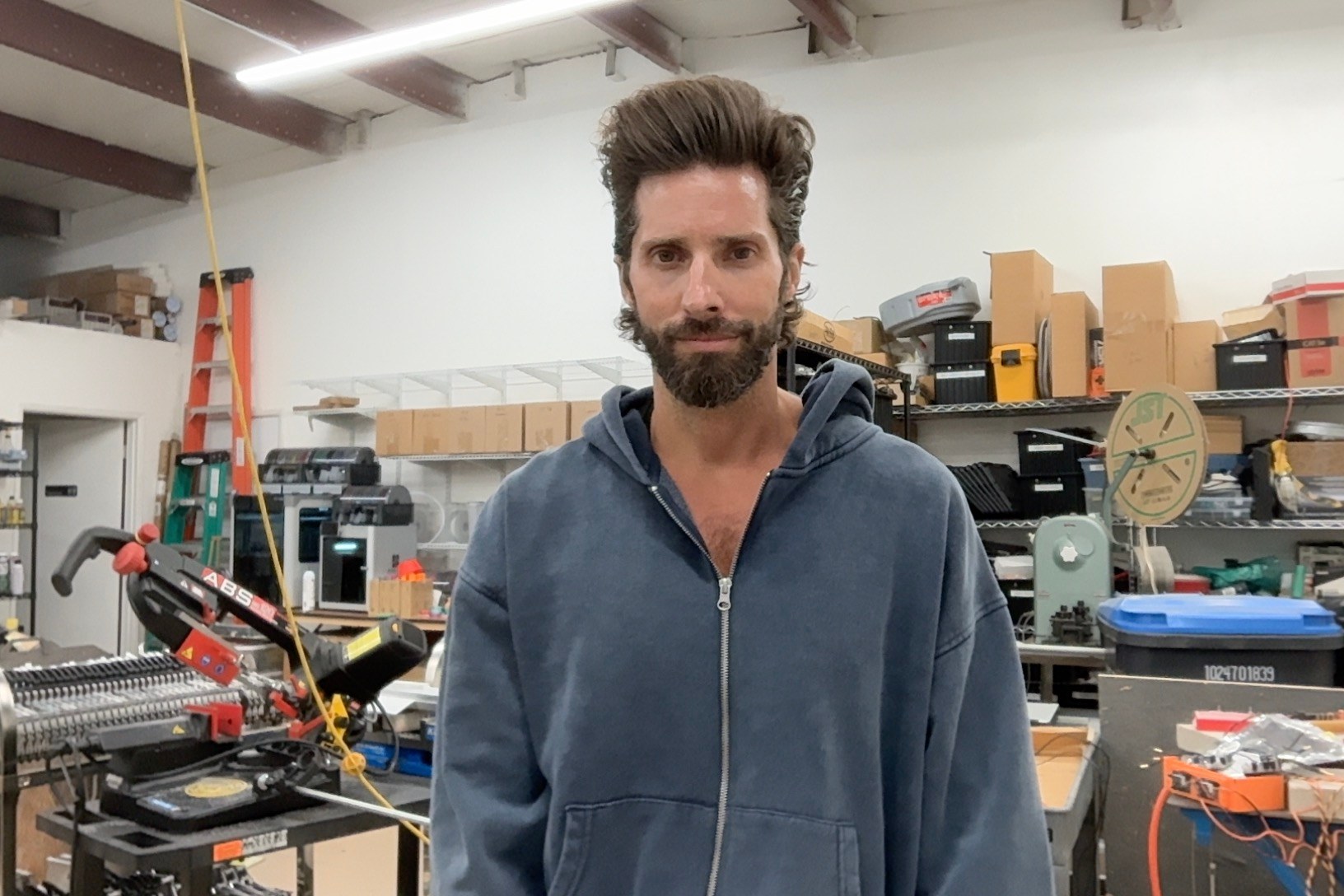
Mark A. Drew is a product designer, inventor and health-technology entrepreneur based in the San Francisco Bay Area. He co-invented the IlluminOss System for minimally invasive fracture repair, which in 2017 became the first orthopedic device to receive De Novo clearance from the US Food and Drug Administration. He is currently co-founder and head of product at Health Machines, which is building agentic infrastructure for healthcare, including APIs and MCP servers that let agents interface directly with diagnostic services, drug databases and virtual clinics.
Drew has built at nearly every layer of healthcare, from inside the body to hospital systems to direct-to-consumer testing, and now agents. In most of those roles he worked from first prototype to clinical or commercial use. His work outside healthcare includes protective flight suits for Kitty Hawk’s electric aircraft and the soft textile exterior of Figure’s humanoid robot.
Early life and education
Drew grew up in Providence, Rhode Island, and later in nearby Barrington. His parents are both artists and educators who taught at the Rhode Island School of Design (RISD): his father is an abstract painter and his mother a watercolor illustrator. Drew went on to study industrial design at RISD, earning a Bachelor of Industrial Design. Before graduating, he won the student track of the Rhode Island Business Plan Competition with Siren Medical, his design for a low-cost device to preserve severed digits and limbs on the way from the field to the hospital.
IlluminOss Medical
In his third year of industrial design at RISD, Drew contacted Robert Rabiner, a serial medical-device entrepreneur who had been in his new office for about a week, and asked to intern at his company, IlluminOss Medical. He became its first employee. IlluminOss was developing a less invasive alternative to titanium rods and pins for fracture repair and fixation: a balloon catheter is inserted into the bone through a small incision, filled with a liquid monomer and cured with light into a rigid implant shaped to the bone. Drew constructed the first catheter assemblies from off-the-shelf parts in the Qosina catalog and co-developed the delivery system that gets the monomer into the balloon. While he was there, the team tested the system in chicken bones and rabbits, ran accelerated-aging tests, and refined it until it was ready for its first clinical trial in humans. The system received the CE mark in Europe in 2009 and went on sale outside the US in 2010. Eight years after the CE mark, in December 2017, it received the FDA’s first De Novo clearance in orthopedics, for fractures of the humerus, radius and ulna caused by metastatic bone disease, and later clearances extended it to other bones. Drew and Rabiner are the two inventors on the original patent, US 7,811,284, and in all Drew is named on twelve granted US patents for the system, the most recent issued in 2025. The system has since been implanted more than 10,000 times.
Massachusetts General Hospital
Drew then moved to Boston, where he spent six years at Massachusetts General Hospital as a product designer and product manager. Working with principal investigator James Stahl, a physician and researcher at the hospital’s Institute for Technology Assessment, he built software on top of the hospital’s real-time location system (RTLS), which tracked radio tags worn by patients and clinicians. From those locations the team derived face time, wait time and flow time data in outpatient clinics, then designed interventions to improve them. During his time there he co-authored four peer-reviewed papers from the work. One, in The American Journal of Managed Care, found that primary-care physicians who spent less face time with patients ordered more tests. The concern, as the paper put it, is that as face time comes under pressure, clinicians may substitute testing for the appropriate history, physical exam and diagnostic reasoning that a visit is meant to allow. The group also developed a normative feedback program that let clinicians compare their performance with their peers’; over a six-month pilot in two clinics, overall variability in face time, wait time and flow time fell significantly.
He also co-developed Godot, a predictive wait-time system for Mass General’s urgent-care clinics, and brought on CenTrak as the program’s main RTLS vendor; CenTrak later won an agreement covering the whole hospital. By the end, the group’s products ran in about a dozen clinics serving more than 100,000 patient visits. The same process-improvement work extended to hospital-acquired infections. Working with STERIS, his team installed RFID readers in its Cal Stat alcohol-based hand-rub dispensers to measure baseline use, then tested interventions to raise it, including an optical pattern on frequently touched surfaces that reminded staff the surfaces were not sterile, and a high-volume dispenser several people could use at once. In 2015 he also guest-lectured in Design+Health, a joint program of Brown University’s Warren Alpert Medical School and RISD, using short design challenges to train medical students in nonlinear problem solving.
Design beyond healthcare
After Mass General, Drew co-founded Simple Machines Research, a product studio that worked with Target, Google and Dartmouth Health, among others. From 2017 to 2020 he worked with Kitty Hawk, the electric-aircraft company funded by Google co-founder Larry Page, on the Flyer, a single-seat electric ultralight that could be flown without a pilot’s license. He led a team that designed critical cabin components, including an ultralight seat. The team also designed protective flight suits for the Flyer’s operators. Because the aircraft had exposed propellers and flew over water, the suits had to be both cut-resistant and buoyant. To solve this, the team partnered with Honeywell to develop a custom yarn from its Spectra ultra-high-molecular-weight polyethylene fiber, bonded to spandex. The suits were then 3D-knit from the yarn and fitted with closed-cell foam chest plates for buoyancy. The suit was tested against high-speed carbon-fiber propeller strikes using ballistic gel and met its acceptance criteria. Those who flew the Flyer in the suit included Larry Page himself; CNN’s Rachel Crane, who became the first journalist to fly it when Kitty Hawk unveiled the new model in June 2018; and, days later, the YouTuber Casey Neistat. The aircraft made more than 25,000 crewed and uncrewed flights before the program ended in 2020. In 2024 Drew led a four-person team on early development of the 3D-knit textile exterior of Figure 03, the humanoid robot later featured on the cover of Time’s Best Inventions of 2025 issue.
PFAS.report and Health Machines
In 2023 Drew and a colleague created PFAS.report, the first clinically validated direct-to-consumer blood testing service for PFAS (per- and polyfluoroalkyl substances, known as “forever chemicals”). They had found a clinical lab that ran an eight-analyte PFAS blood panel no one was selling to consumers, and built the service around it in a week. It included a calculator that converted raw analyte values into a single exposure score, benchmarked against National Academies guidance. Drew launched it on Hacker News with his own results, and it quickly reached the front page. Seven months later, one of the big national labs began offering consumer PFAS testing.
From 2024 to 2026 Drew was director of marketing at a venture-backed consumer AI startup, where he co-designed about a dozen generative AI products. He also designed and built a demand-testing system for product ideas, using paid social ads and landing-page conversions as a proxy for product-market fit before anything was built.
In 2026 Drew launched Health Machines, which builds single-purpose machines for AI agents: APIs, MCP servers and command-line interfaces that connect agents directly to health services. Its first machines handle lab ordering and results retrieval, and offer a free API for drug lookup and interactions data. Drew has said the aim is to rethink the system for agents “so bureaucracy doesn’t dictate care.”
Personal life
Drew lives in Lafayette, California, where he hikes regularly. He manages an autoimmune disease and considers his patient perspective one of his greatest strengths.